Pocock Singles Project
Husky Challenger Restoration
Restoration of an Eight Oared Wooden Racing Shell
1/3/12
| August 3, 2011 Dianne, The restored Husky Challenger boots and foot stretchers were delivered today. Good luck with a rapid restoration with the rest of this wonderful Pocock shell. Guy | 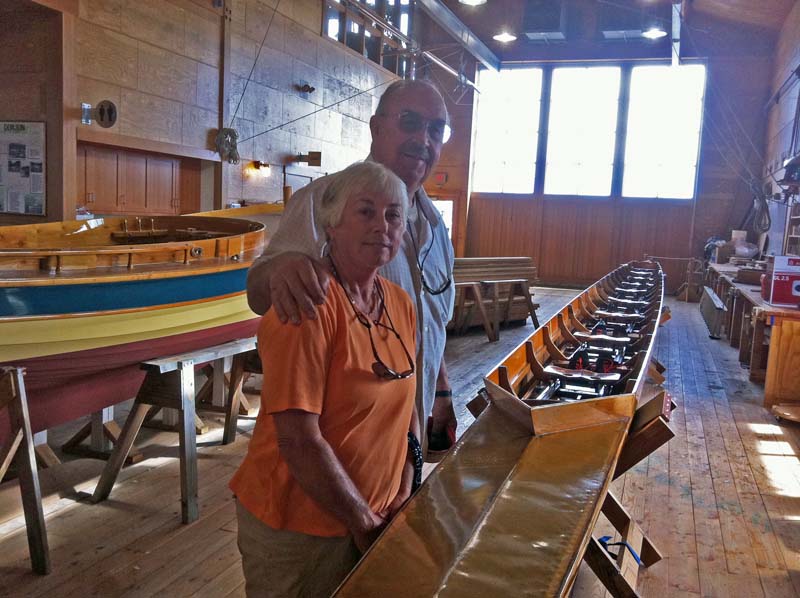 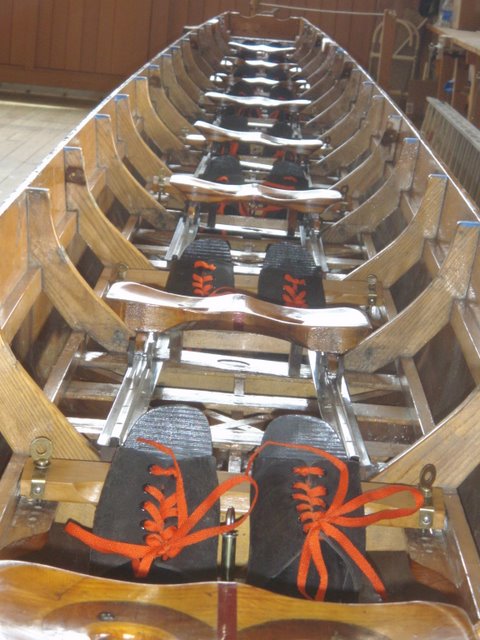 Click picture for larger image. |
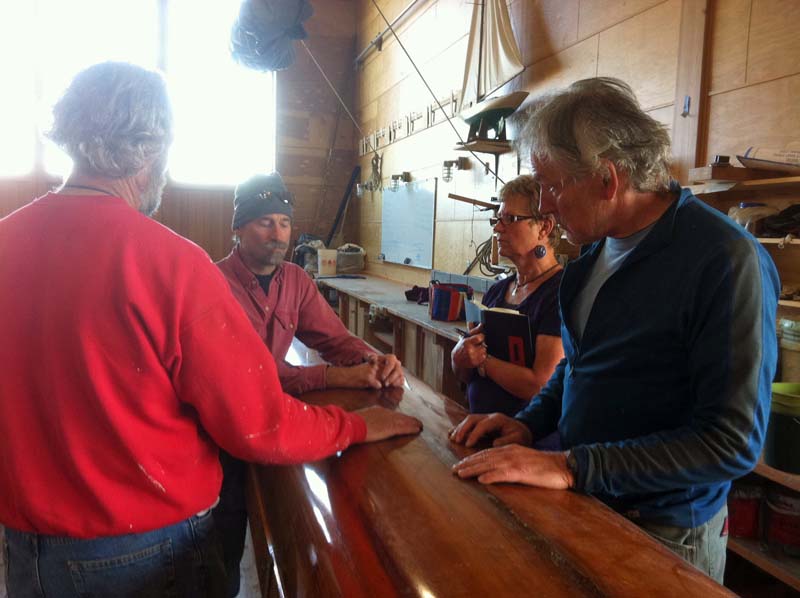 Ted Shoulberg, Steve Chapin, Dianne Roberts and Jim Mason with HC in Maritime Center. | 6/25/11 Dianne et al, First, let me state there is no need for you to respond immediately to this email...it's just that I made a call to Stan and to Frank today and I wanted to pass along their thoughts and suggestions for the record regarding improvements for the HUSKY CHALLENGER retrofit program. We can discuss details and any changes that you may consider later. I have copied Steve so that he may advise on the following comments as well....and so, here's the basis of our conversations........ |
| Stan Pocock and I briefly discussed the background of the HUSKY CHALLENGER. He advises they built the HC in 1956 and it was then sent to Syracuse, NY as one of three shells to be stored at the NY Fairgrounds rather than be sent back to Seattle. It was used in the IRA yearly races for about three years....he was not sure when the boat was returned to Seattle. This Eastern storage was necessary as the UW crews started to fly back and forth rather than take the train that had previously transported the shells each year. As you mentioned, the HC was rowed at San Diego at the Nationals in 2004 and the current goal is for the NAILS to use it in competition once again in San Diego in 2012. As you recall, I had mentioned a couple of other points regarding this wood shell. One being the bronze row locks and the angle of blade entry into the water. The existing HC row locks probably have a built in angle of 7 to 9 degrees with wood oars having a flat or perpendicular zero pitch angle. Frank advises 7 to 9 degrees is the ideal angle for the entry of the blade into the water. If you are using the carbon fiber oars, they may already have a degree of pitch which means the blade entry would be too sharp and consequently using those oars may be more difficult than necessary. To measure this angle, Frank advises to place a carbon fiber oar on a flat floor surface so that the entire contact area with the row lock is 90 degrees to the floor. Then measure the angle of blade at the cup? If there is angle detection, then there may be a blade entry issue..... Frank continued that hatchet blades and the old bronze row locks are not a good combination and that the tulip blade oars should be used. I also mentioned the alterations that Frank Cunningham made to a set of carbon fiber oars for the SYC Women’s team a few years ago. As I recall, he cut off about 1 1/2 inches from the handle and about 1 inch off at the end of the blade. He also reduced the width of the blade on both sides by 3/8 of an inch. I remember rowing with this set of oars very well as our SYC mixed team used them once and set a Master's record for the 2000 meter in the Montlake Cut. As you are aware, todays oars are basically made for the strong college athletes and so it makes a lot of sense to cut them down for a more mature Master's group of rowers.... It would be interesting to have Steve respond regarding Frank's comments as these suggested oar revisions should result in a reduced the load on the oar. Also the shorter handle will allow for a greater swing due to the reduced arc and the oars should sweep thru the water much easier due to the reduction of blade area. Again, I speak from a first hand experience after using the SYC Cunningham revised oars. This is really something to consider as it makes rowing more of real experience and more of a pleasure! Frank will be at the September WBF and those interested parties may want to discuss further. Again, I realize you have other responsibilities that require your attention, however, I thought it best to put these remarks on record. Will advise further regarding the boot stretchers, the seats and also I have a couple of new thoughts on a NAILS rowing trophy..... Regards, |
| 12/6/11 Hi Friends of the Husky Challenger, Here's a quick update on what's been happening with the Husky Challenger - After a bit of stumbling about figuring out space issues in the boatshop, Ithink we've come up with a workable system that keeps the boat accessiblefor work sessions but still possible to get out of the way when necessary toaccommodate other projects in the shop. With big thanks to Steve Chapin and Scott Jones, not to mention the boatshopvolunteers, it is now hanging in slings tied to the big overhead beam andcan be lifted, carefully, with some effort, as high as necessary. Scott iskindly allowing us to leave it in place at working level and will have theboatshop guys lift it when necessary - which saves a lot of wear and tear onthe Nails, as well as the nails. Several of us spent Sunday a couple of weeks ago doing some cleaning on theinside, per Steve's instructions. That was followed by a miserably failedexperiment (by Mari, Ann and me) last Wednesday night with two differenttypes of strippers. Basically, the strippers - when they worked at all -removed not only the bubbled, loose varnish, but also the varnish thatsecures the layer of cloth to the inner side of the hull, leaving a blotchy,white layer that is pulling away from the hull and bubbling even more. Inaddition to not working very well, the strippers were absolutely nasty towork with. Unless we want to remove all the cloth - a job that would beimpossibly time-consuming, really ugly to do, and add the even harder job ofreplacing the cloth with a new layer - it seems very clear that stripping isnot for us. (At least not that kind of stripping.) Steve inspected the messwe made and concurs - in fact, he said he's having a similar issue onanother boat he's working on. He did say we'll be able to fix up the bit wemessed up, though, so all is not lost. Steve's recommendation for the inside of the boat, which we are nowvigorously following, was to use small scrapers, pocket knives and the liketo carefully scrape away the bubbled and loose varnish without damaging theunderlying cloth layer. This will be followed with additional cleaning andsanding before revarnishing. The end result will probably be a sort ofpolka-dot effect where all the bubbles were, but at least the cloth and thevarnish will be sound. Over time, the color differences should mellow a bit,so it shouldn't look too bad. It can be the Polkadot Pocock. Also following Steve's tips 'n tricks, we managed to remove all theremaining hardware without having to drill out the frozen screws - THANK YOUSteve! At least five of us were there for several hours this past Sunday, andMonday evening, and I think we made good progress on the varnish/bubblescraping task. In fact, we're probably ready to begin the initial sanding onthe interior. I'll try to get together with Steve in the next day or two tohave a look and receive his wisdom. Our current work schedule is: Sundays from 11:00 am to 3:00 pm, Mondayevenings from 6:30 to 8:30, and Friday daytime whenever people can show up(since the shop is already open.) Next week (December 12-18) several of us(including me) will be out of town, so if you would like to work in myabsence, please let me know before THIS Sunday (the 12TH) and I will makearrangements to get you the key and make sure you know the lockup proceduresin the boathouse. I don't think anyone (so far) can come on Friday this week- give me a call if you want to work and I'll fill you in on what the nextsteps are. Also - in general, PLEASE LET ME KNOW AHEAD IF YOU PLAN TO WORKON ANY GIVEN DAY/TIME SO I KNOW TO CONTACT YOU IF ANYTHING CHANGES.Sometimes there are events or other situations in the boatshop that I don'tknow about until the last minute and I'd like to be able to call you and letyou know of any schedule changes. The best communication method for me iseither email or text message, since I get email on my phone. But a phonecall on my cell is fine, too - just harder for me to remember sometimes. Realistically, we will likely not resume the full schedule until afterChristmas, since so many will be gone over the next couple of weeks. Again,if you have time available, give me a call/email and I'll make arrangementsfor you to get access. I hope we'll be far enough along to begin repairing cracks early in January- there's still a lot to do. I have a few more photos that I will try to get posted to the Husky Challenger Restoration Picasa page. Please give me a day or so to get themuploaded - thanks. Row long, |

Pocock Singles Project
Copyright 2005 - 2012 Wooden Boat Foundation
All rights reserved.
webmaster